
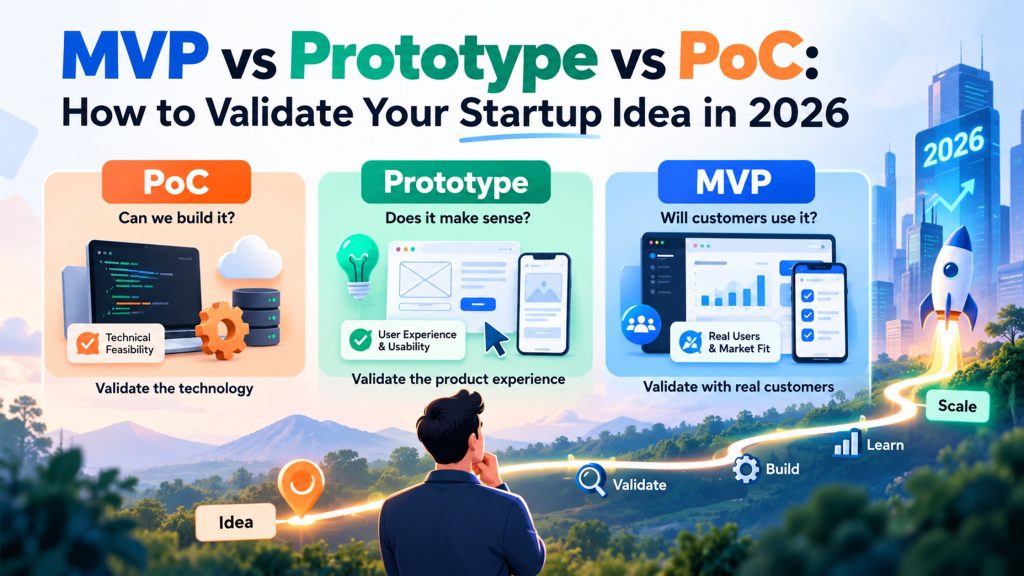
Understanding these differences is particularly important in 2026. AI-assisted development, low-code platforms, reusable cloud infrastructure, and rapid prototyping tools have made it easier to build products quickly. But faster development does not eliminate the need for validation. In fact, it can make disciplined validation even more important because startups can now build the wrong thing faster.
This guide explores MVP vs Prototype vs PoC, how each approach works, when you should use it, and how to choose the right validation strategy for your startup idea in 2026.
Why Startup Validation Matters More Than Ever
A common mistake among entrepreneurs is moving directly from an idea to full-scale product development. Imagine you have an idea for an AI-powered customer support platform. You hire developers, create dashboards, integrate payment systems, build administrative features, and spend months developing the platform. Then you launch—and discover that customers do not trust the AI responses or that the core AI functionality does not perform reliably with their data. Much of that investment could have been avoided by validating the riskiest assumptions earlier.
Startup validation is therefore about answering critical questions before making larger investments:
- Is the technology technically feasible?
- Does the product solve a meaningful problem?
- Can users understand the proposed experience?
- Are customers interested enough to try it?
- Will they continue using it?
- Are they willing to pay?
- Can the business model eventually become sustainable?
PoCs, prototypes, and MVPs allow founders to answer different parts of these questions without immediately building the complete product.
What Is a Proof of Concept (PoC)?
A Proof of Concept, commonly called a PoC or POC, is a small
experiment designed primarily to determine whether a particular technical
concept is feasible.
Its central question is:
“Can we actually build this?”
A PoC is generally created for internal evaluation rather than customers. It
may contain experimental code, sample data, temporary integrations, or a very
basic interface. The goal is not to make something beautiful or
production-ready. The goal is to prove or disprove a technical assumption.
Example of a PoC
Suppose a startup wants to develop an AI application capable of extracting
information from thousands of complex financial documents.
Before developing the complete application, the technical team could create a
PoC that:
- Takes a representative collection of documents.
- Processes them using selected AI models.
- Extracts several important fields.
- Compares the output against verified data.
- Measures accuracy, latency, and processing cost.
If the technology performs well enough, development can continue.
If it does not, the startup can investigate another technical approach before
spending money building dashboards, authentication systems, billing modules,
and other product features.
When Should You Build a PoC?
A PoC is particularly valuable when your startup involves significant
technical uncertainty, such as:
- Artificial intelligence and machine learning
- Retrieval-Augmented Generation (RAG)
- Computer vision
- Internet of Things (IoT)
- Complex API integrations
- Blockchain applications
- Legacy-system integration
- Large-scale data processing
- Unusual automation workflows
- Real-time or high-performance systems
If the technology itself is already well understood, however, a separate PoC
may simply add unnecessary work.
What a PoC Does Not Validate
A successful PoC does not prove that customers want your
product.
It only demonstrates that the specific technical concept you tested appears
feasible under the conditions of your experiment.
You could have an impressive AI algorithm and still have no viable market for
it.
That is why technical validation and market validation should never be treated
as the same thing.
What Is a Prototype?
A prototype is an early representation of how your product might look, behave, or feel.
Its main question is:
“Does this product experience make sense?”
Unlike a PoC, which focuses primarily on technical feasibility, a prototype usually focuses on design, usability, user journeys, functionality concepts, and interaction. Current product-development guidance similarly distinguishes prototypes as tools for validating interaction and usability before production development.
A prototype does not necessarily require a functioning backend. It could be as simple as sketches on paper or as sophisticated as a highly realistic interactive interface.
Types of Prototypes
Low-fidelity prototypes may include sketches, basic wireframes,
and simple screen layouts. These are useful during the earliest stages of
product planning.
High-fidelity prototypes look much closer to a finished
application. Buttons may work, screens may transition, and users can simulate
completing important tasks even though the underlying backend does not exist.
Example of a Prototype
Imagine you are developing a mobile application that helps small retailers
manage inventory.
Before building the complete system, you could create an interactive prototype
showing:
Login → Dashboard → Add Product → Inventory →
Low-Stock Alert → Purchase Order
You could then give the prototype to several store owners and ask them to
complete typical tasks.
Their behavior could reveal problems immediately. Perhaps users cannot find the
“Add Product” option. Maybe they expect low-stock information directly on the
dashboard. Perhaps the purchase-order process requires too many steps.
These discoveries can be addressed before developers spend time implementing
the complete workflow.
When Should You Build a Prototype?
Consider creating a prototype when:
- Your user journey is complicated.
- You are unsure about the interface.
- You need early customer feedback.
- Multiple user roles have different workflows.
- You need to communicate the idea to stakeholders.
- You want usability testing before engineering begins.
- You need something visual for investor presentations.
- You want to compare different product concepts.
What a Prototype Does Not Prove
A beautiful prototype can create the impression that the product is almost
complete. It may not be.
A prototype usually cannot prove that the backend will scale, an AI system will
perform reliably, integrations will work under production conditions, or
customers will actually pay for the service.
Most importantly, positive feedback such as “I would definitely use
this” is not the same as observing someone actually using and paying for
the product.
For that level of validation, you generally need an MVP.
What Is an MVP?
An MVP, or Minimum Viable Product, is the smallest functional version of your product that delivers its core value to real users.
Its primary question is:
“Will customers actually use this?”
And, depending on the business model:
“Will customers pay for it?”
This is the major difference between an MVP and a prototype. An MVP is not merely demonstrating what the product could do. Real users should be able to use it to accomplish the core job the product promises.
Example of an MVP
Imagine you want to build a comprehensive project-management platform.
Your long-term roadmap includes:
- Project dashboards
- Tasks
- Team collaboration
- AI recommendations
- Time tracking
- File management
- Video meetings
- Reports
- CRM integration
- Automated invoicing
Building everything before launch could take months or years. Instead, your MVP might contain only:
Create Project → Add Tasks → Assign Team Members →
Track Progress → Receive Notifications
That is enough for customers to experience the central value proposition.
You can then observe how people actually use it. Which features do they use
most? Where do they abandon the workflow? Do they return the following week?
What do paying customers request?
Those insights can guide the next development cycle.
MVP vs Prototype vs PoC: Key Differences
| Factor | PoC | Prototype | MVP |
|---|---|---|---|
| Main question | Can we build it? | Does the experience make sense? | Will customers use/pay for it? |
| Primary purpose | Technical validation | UX/concept validation | Market validation |
| Primary audience | Internal/technical team | Test users and stakeholders | Real customers |
| Functionality | Limited experiment | Simulated/partial | Functional core product |
| Backend required? | Only if relevant to test | Usually no | Usually yes |
| Production-ready? | No | No | For the defined use case |
| Real customers? | Usually no | Sometimes for testing | Yes |
| Revenue generation | Usually no | Usually no | Possible |
| Typical outcome | Feasibility decision | UX/product decision | Product/business decision |
The most important difference is not how polished each version looks. It is
what uncertainty you are trying to remove.
PoC vs Prototype: What’s the Difference?
PoCs and prototypes are often confused because both occur before full product
development.
A PoC validates technology, while a
prototype validates the product experience.
Suppose you are creating an AI-powered medical-document management platform.
A PoC might test whether your AI model can accurately extract specific
information from documents.
A prototype might show healthcare professionals how they upload a document,
review extracted information, correct mistakes, and export the results.
One tests the engine. The other tests the
experience around the engine.
Prototype vs MVP: What’s the Difference?
The difference here is primarily between
simulated usage and real usage.
A prototype may allow someone to click a “Make Payment” button and see a
success screen. No money necessarily moves.
An MVP would connect that workflow to real payment infrastructure so an actual
transaction could occur.
Similarly, a prototype of an AI chatbot might show predetermined answers. An
MVP needs the AI system to process actual user requests.
Prototype = experience the idea.
MVP = experience the real core product.
PoC vs MVP: What’s the Difference?
A PoC proves that a particular technical approach can work. An MVP determines
whether that capability creates enough value for real users.
For example, a startup might develop a PoC proving that computer vision can
identify damaged components from photographs.
But it does not prove that manufacturing companies will integrate the system
into their inspection processes or pay for it.
An MVP could package that technology into a simple application where inspectors
upload photos, receive damage classifications, review results, and generate
reports.
Real-world usage would then produce evidence about customer value.
Do You Need PoC → Prototype → MVP Every Time?
No.
One of the biggest mistakes founders can make is treating these three
approaches as mandatory stages.
The correct process depends on where your uncertainty lies.
If your technology is uncertain:
Idea → PoC → Prototype → MVP
If the technology is straightforward but the user experience is
uncertain:
Idea → Prototype → MVP
If the technology and user journey are already well
understood:
Idea → MVP
The goal is not to complete every stage. The goal is to choose the
smallest and fastest experiment capable of answering your most important
unanswered question.
How AI Is Changing Product Validation in 2026
Product validation is evolving rapidly in 2026.
AI-assisted coding, generative design, reusable components, low-code/no-code
platforms, cloud services, and ready-made APIs are reducing the amount of work
required to turn concepts into testable products.
This creates an interesting opportunity for startups.
Instead of spending months creating something before getting feedback, teams
can run smaller validation cycles:
Hypothesis → Build → Test → Measure → Learn → Improve
But speed creates another risk.
When building becomes easier, teams can become tempted to add features simply
because they can.
A successful startup still needs to ask:
“What assumption are we testing?”
AI can accelerate development. It cannot replace product strategy or genuine
customer evidence.
AI Startups May Need PoCs More Than Traditional SaaS Startups
This distinction becomes particularly important for AI startups.
Suppose you are building an enterprise AI assistant using Retrieval-Augmented
Generation (RAG).
Before building the complete SaaS platform, you may need to validate:
- Retrieval accuracy
- Response quality
- Hallucination frequency
- Document processing
- Permission-aware retrieval
- Response latency
- Model costs
- Context limitations
- Reliability across different datasets
That makes a PoC extremely valuable.
Once the AI capability reaches an acceptable standard, you can prototype how
users interact with it.
Then an MVP can answer the commercial question:
“Will companies incorporate this AI assistant into their daily workflow
and pay for it?”
A Practical Startup Validation Framework for 2026
Instead of immediately asking, “Should we build an MVP?”, start by identifying
your largest risk.
Step 1: Define the Problem
Write down exactly what problem you believe exists.
For example:
Small e-commerce businesses spend too much time manually responding to
repetitive customer-support questions.
That is much stronger than:
We want to create an AI chatbot.
Start with the customer problem—not the technology.
Step 2: Identify Your Riskiest Assumption
Ask what would cause the business to fail if your assumption turned out to be
wrong.
Technical risk: Can the technology perform the required task?
Usability risk: Can customers understand and successfully use
the proposed workflow?
Market risk: Does anyone care enough about the problem to adopt
or pay for your solution?
Step 3: Choose the Smallest Validation Method
Match your risk to the right approach:
- Technical uncertainty → PoC
- UX/workflow uncertainty → Prototype
- Market/demand uncertainty → MVP
Step 4: Define Success Before Building
Do not decide whether your experiment succeeded after seeing the results.
Define success criteria beforehand.
For an AI PoC, that might be a required accuracy or latency threshold.
For a prototype, it might be the percentage of test participants who complete
the primary workflow without assistance.
For an MVP, you might measure:
- Activation rate
- Trial-to-paid conversion
- Retention
- Repeat usage
- Customer acquisition cost
- Churn
- Feature adoption
- Customer feedback
- Revenue
Metrics should reflect the assumption you are testing.
Step 5: Learn Before Adding Features
After launching your experiment, resist immediately adding more functionality.
Analyze what happened.
If users abandon onboarding, adding ten more features will not solve the
underlying problem.
If customers repeatedly use one particular feature, that behavior may reveal
where your strongest value proposition actually lies.
Your product roadmap should increasingly be driven by
evidence rather than assumptions.
Common Mistakes Startups Should Avoid
1. Building an MVP Too Early
If the core technology is highly uncertain, developing a complete MVP before
proving technical feasibility can waste considerable resources.
Validate the hardest technical assumption first.
2. Turning an MVP Into a Miniature Full Product
“Minimum” is there for a reason.
Your MVP does not need every feature on your three-year roadmap. It needs
enough functionality to deliver and test the core value proposition.
3. Confusing a Beautiful Prototype With Market Validation
Investors may love your demo. Test users may praise your design. Neither
automatically means customers will pay.
4. Testing With the Wrong Audience
Feedback from friends, colleagues, or people outside your target market can be
misleading.
Validation becomes more valuable when participants closely resemble your
intended customers.
5. Measuring Vanity Metrics
Downloads, page views, impressions, and registrations can look impressive.
They may tell you little about whether customers receive meaningful value.
Retention, repeated usage, conversions, referrals, and revenue often provide
stronger signals.
6. Building Features Instead of Testing Assumptions
Every feature should have a reason to exist.
Ask:
“What will we learn by building this?”
If the team cannot answer that question, reconsider whether the feature belongs
in the current validation stage.
Final Thoughts
The debate around MVP vs Prototype vs PoC is not about deciding which approach is universally better. Each exists to reduce a different type of uncertainty.
- A Proof of Concept reduces technical uncertainty.
- A Prototype reduces product-design and usability uncertainty.
- An MVP reduces market and customer-demand uncertainty.
For startup founders in 2026, the smartest approach is not necessarily to build more—it is to learn more with the smallest sensible investment. Before hiring a large development team or creating an extensive feature roadmap, identify the assumption that could most seriously damage your startup
if it turns out to be wrong. Then choose the simplest way to test it. Sometimes that means a technical PoC. Sometimes it means a clickable prototype. And sometimes it means putting a focused MVP directly into the hands of real customers.
The objective is the same in every case:
Validate early, learn quickly, reduce risk, and invest heavily only when the
evidence gives you a reason to move forward.